
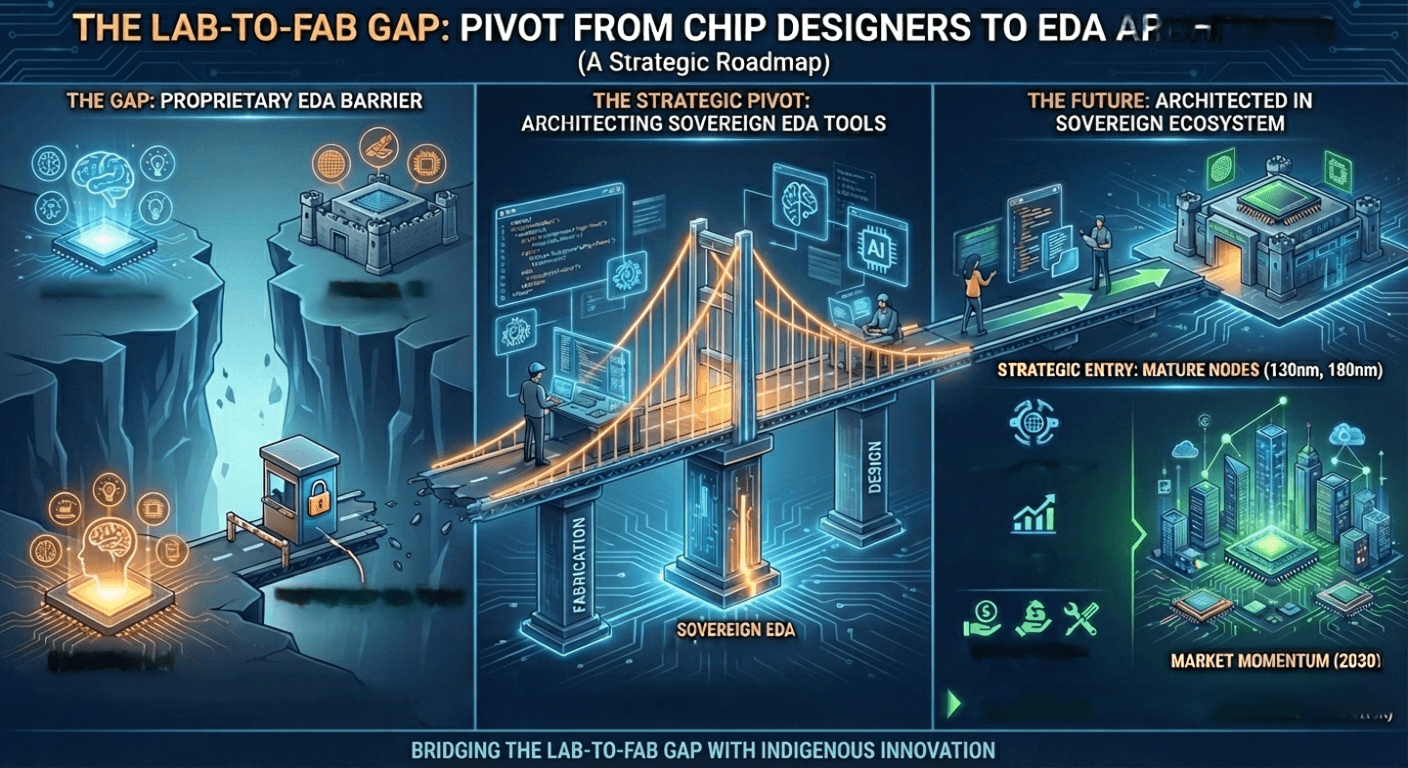
The Lab-to-Fab Gap: Need for essential pivot from Chip Designers to EDA Architects
Introduction
The global semiconductor race is often visualized through the lens of massive "Fabs"—monolithic manufacturing plants costing upwards of $10 billion to $20 billion [1, 2]. While India's recent progress in securing fabrication partnerships is a monumental step, a critical gap remains in the shadows: the Electronic Design Automation (EDA) software stack.
At SoCTeamup Semiconductors, we believe that for a nation with a world-leading software DNA, the most strategic pivot is not just in designing chips or building fabs, but in architecting the tools that bridge the gap between the two.
The Three Pillars of Sovereignty
True self-reliance in the semiconductor space rests on three pillars:
1. Fabrication: The physical manufacturing capacity.
2. Design: The architectural blueprint of the chip.
3. EDA Tools: The specialized software used to create, simulate, and verify those blueprints.
While India currently hosts nearly 20% of the world's semiconductor design engineers [3, 4], most utilize proprietary, foreign-licensed toolchains. With top-tier EDA licenses costing upwards of $50,000 to $500,000 annually per seat [5], this creates a significant barrier to entry for local startups and academic researchers. This is the "Lab-to-Fab Gap"—the distance between an innovative academic idea and a manufacturable piece of silicon.
The Software Powerhouse Advantage
India ranks 1st globally in AI skill penetration [4]. EDA is essentially a complex software problem involving high-performance computing (HPC) and advanced algorithms. By shifting our focus from being "tool users" to "tool architects," we can leverage our software strength to disrupt the status quo.
- AI-Driven Automation: AI-based design automation can reduce design time by nearly 25% and improve prediction accuracy by 30% [5].
- Scale via Cloud-Native Tools: India's cloud mastery means we can build distributed EDA platforms that run 10,000 simulations in parallel, a feat legacy desktop-bound tools struggle to match [6, 7]. By leveraging "burst" compute capacities, engineers can accelerate the verification phase from weeks to days [7].
- Workforce Scale: India's semiconductor talent pool is projected to grow from 250,000+ professionals today to over 400,000 by 2030 [8].
The Strategic Entry Point: Mature Nodes
The industry often chases the "bleeding edge" (3nm or 5nm), but the strategic path for architecting a new EDA ecosystem begins at mature nodes like 130nm or 180nm.
1. Massive Demand: The market for legacy nodes exceeds $50 billion [9], powering the sensors and controllers essential for automotive and IoT sectors [7].
2. Cost-Effectiveness: Wafer costs at mature nodes remain significantly lower than the $20,000+ required for ultra-advanced nodes [2, 10].
3. Open Source Foundation: The release of open PDKs (Process Design Kits) and the OpenROAD project has proven that a "no-human-in-loop" flow can generate a chip layout in under 24 hours [11].
Building the Indigenous Roadmap
The Indian government's Chips to Startups (C2S) and Design Linked Incentive (DLI) schemes are already laying the groundwork:
- Democratizing Access: Initiatives like the ChipIN Centre provide academic institutions and startups with centralized access to high-end EDA infrastructure [4].
- Indigenous Processors: Success stories like the DHRUV64 microprocessor—a fully indigenous 64-bit dual-core chip developed under the DIR-V program—demonstrate India's capacity to build and scale homegrown tech [12].
Market Momentum by 2030
The potential for India to lead in this space is backed by strong economic indicators:
- Market Reach: India's semiconductor consumption is projected to reach $100–$110 billion by 2030, growing at a 13% CAGR [1, 13].
- EDA Growth: Domestic EDA revenue is expected to grow steadily at a 10.2% CAGR, reaching over $730 million by the end of the decade [8].
Conclusion: The Path Forward
The pivot from chip designer to EDA architect is a national imperative. By mastering the EDA stack through open-source technologies, leveraging cloud-native scalability to run thousands of simulations simultaneously, and focusing on mature nodes for immediate market impact, we can finally bridge the Lab-to-Fab gap.
The next era of silicon won't just be "Made in India"—it will be "Architected in India."
---
References
1. Blackridge Research, "Semiconductor Fabrication Plants in India: 2025 Update," Jan 2025.
2. PatentPC, "Chip Manufacturing Costs: 3nm Fab Investment Analysis," Dec 2025.
3. The Times of India, "India Hosts 20% of World's Chip Design Engineers," Sep 2025.
4. PIB Delhi, "India's Semiconductor Vision: 3nm Design and Talent Initiatives," Jul 2025.
5. Market Growth Reports, "Electronic Design Automation (EDA) Software Market Forecast," Nov 2025.
6. AWS for Industries, "Economics of EDA on AWS: License Cost Optimization," 2025.
7. Synopsys Blog, "EDA in the Cloud: Scaling Verification to 10,000+ Cores," 2025.
8. PwC, "Semiconductor and Beyond: India's Talent Pool Growth Report," Sep 2025.
9. Orbit & Skyline, "Legacy Tool Management: Extending Semiconductor Lifespans," Jan 2025.
10. Chetan Patil, "The Key Factors in Semiconductor Node Selection," Feb 2025.
11. OpenROAD Project & SkyWater Foundries, "Open-Source PDK and 24-Hour Design Flows," 2025.
12. PIB India, "DHRUV64: India's First 1.0 GHz Indigenous dual-core Microprocessor," Dec 2025.
13. Deccan Herald, "India Semiconductors: Sector to Hit $103 Billion by 2030," Sep 2025.